Trimming and assembling sofubi: heat gun, hot water and the heat box
Why soft vinyl parts are trimmed and joined warm, three ways to soften them, how to cut without hurting yourself, and the order I assembled my figures in.
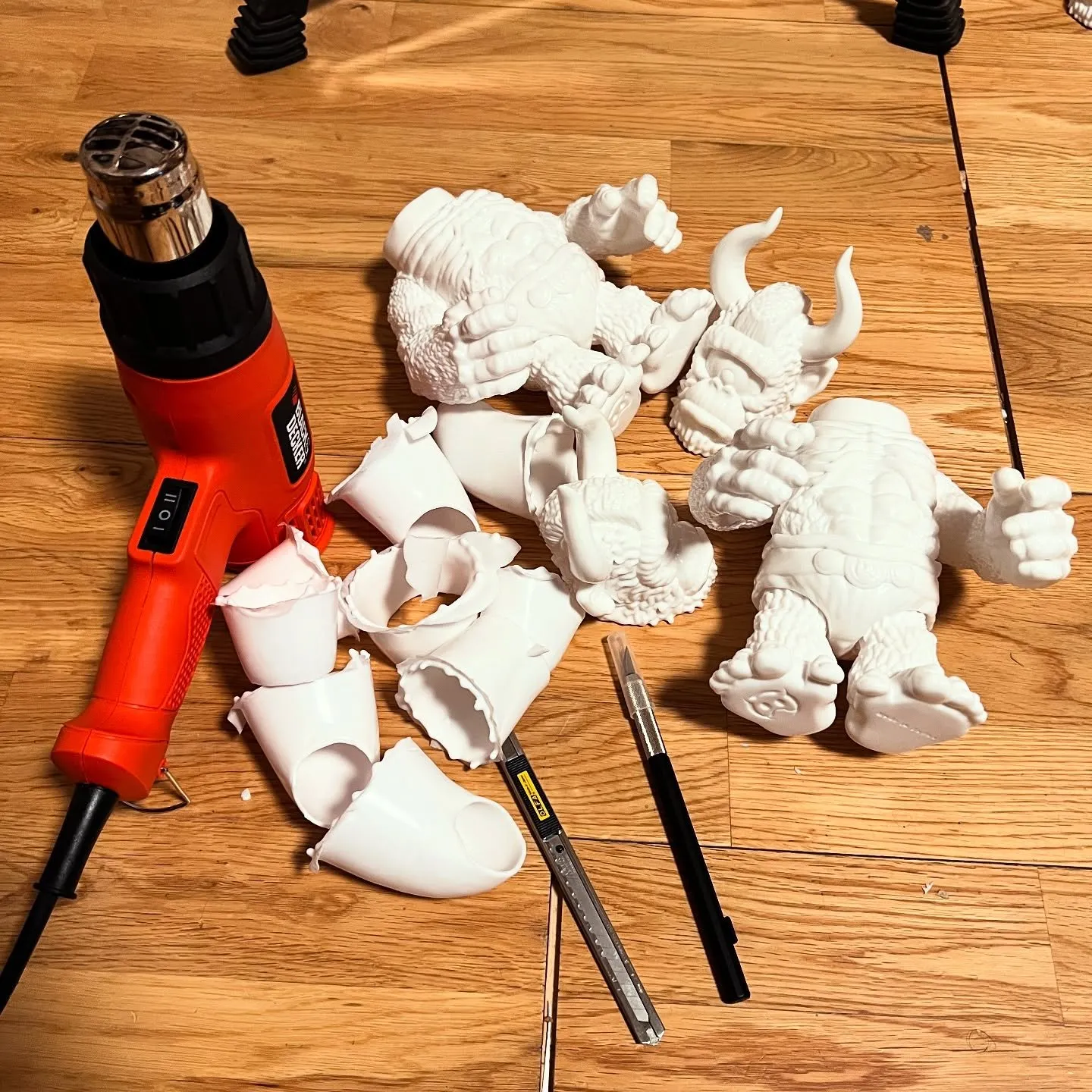
Sofubi parts don’t come out of production ready to snap together. The openings where the parts join often carry a rim of extra vinyl, and the joints are tight on purpose, so the figure holds together once assembled. Cold vinyl is stiff: hard to cut cleanly and almost impossible to press into place. Warm vinyl is soft and forgiving. Nearly every step in this article comes down to warming the parts the right way.
Three ways to soften vinyl
1. The heat gun
For a single piece, a heat gun is the quickest way: warm the part, then trim it with a knife. I used one for years, both for trimming and for pressing parts together.
It has two serious drawbacks. It only warms one piece at a time, which is slow for a batch. And a jet of very hot air on one spot can deform the vinyl, while overheated vinyl gives off fumes you should not breathe. You can’t set a precise temperature on most heat guns, and my air-quality meter and air purifier reacted every time I used one.
That is not just a feeling. Soft vinyl is PVC, and when PVC is overheated it starts to break down and release hydrogen chloride, an irritating, corrosive gas. Laboratory studies put the start of that release at around 100 to 200 °C, depending on the formula, while a heat gun’s air can be several hundred degrees.
If you use a heat gun, keep it moving, keep it at a distance, warm the part only until it is soft, and work with good ventilation. Never let the vinyl bubble, smoke or change colour.
2. Hot water
A tub of very warm water with a little soap softens many pieces at once, and cleans them at the same time. For a batch it is much faster than the heat gun.
The downsides are practical. The water cools down as you work, so you have to top it up. And hands that stay wet for a long cutting session get soft skin, which makes holding a knife harder and the skin sore. Take breaks and dry your hands.
Be careful with the temperature. Water hot enough to soften vinyl is hot enough to scald: at 60 °C, a deep burn can happen in about five seconds on an adult’s skin, and in about one second on a child’s. Use tongs or a strainer rather than your fingers, and keep the tub where it can’t be knocked over.
3. The heat box
This is the method I learned from Japanese sofubi makers, and it is the one I recommend for batches. It is simply a box that keeps warm air around many parts at once.
To build one:
- Take a cardboard box, not a plastic one, because the box itself gets warm. Tape it closed.
- Cut a small door in the side to put parts in and take them out.
- Cut a round hole in the top that fits the nozzle of a hair dryer.
- Use a cheap hair dryer that won’t overheat. The box can be any size you need.
Load the box with parts, run the dryer for a few minutes until they are soft, then take out one piece, trim it, and take the next while the rest stay warm. I cut a great many Geckogons this way.
Stay with the box while the dryer runs, and switch it off when you are done.
Cutting safely
Most of my cuts happened when a piece wasn’t soft enough and I pressed too hard. If you have to force the knife, the part is too cold: warm it again.
- Use a sharp hobby knife. A blunt blade needs more force and slips more easily.
- Cut away from the hand holding the part.
- Wear protective gloves when the parts are hot. I did, especially when trimming the extra plastic inside the head and arm sockets.
Trimming the inside of the sockets is boring work, but it pays off: the joints turn more easily, and the parts go together without a fight.
Assembly order
Assembly is where warm vinyl matters most. You often have to put your fingers inside a hot part to press the joint home, so work with gloves and don’t rush.
For Borgor, my order was:
- Join the skirt to the legs, then the upper and lower halves of the body.
- Fit one arm.
- Fit the head.
- Fit the last arm.
Keeping one arm for last leaves you a gap to hold and support the body while you press the head in. After assembling more than two hundred Borgors, that order became automatic.
In short
- Warm the parts evenly and gently. Soft, not hot.
- For batches, use a heat box or warm water rather than a heat gun.
- If you use a heat gun, keep it moving and ventilate. Overheated vinyl gives off harmful fumes.
- Never force the knife. Re-warm the part instead.
- Gloves for hot parts, and a fixed assembly order.
Preparing sofubi for paint covers washing the parts after trimming. A safer small studio covers ventilation and fumes in more depth.
Sources
I wrote this article from these videos of mine. Safety and product facts are checked against the manufacturers’ published data.