Designing for production: think about moulds and masks from day one
What soft vinyl moulds can and can't do, how every part and colour adds cost, and the checklist I wish I had used before my first toy.
“You can’t design a toy without thinking about how you are going to manufacture it.” It took me a few expensive lessons to learn that sentence. Designing feels like the easy part, because on paper you control everything. The problems start at the factory, and every problem you could have avoided on paper costs money there.
Decide the material before you draw
My advice is to decide your market and your material before you design anything. A slim, delicate figure might look great as resin and be impossible as sofubi. If you know from the start that the toy will be soft vinyl, you design for soft vinyl.
It also helps to watch how toys are actually made. Factory videos of sofubi casting, rotocast vinyl and resin printing show you what level of detail each process can hold.
Shapes that fail in sofubi
Soft vinyl is cast as a hollow skin inside a metal mould, so it loves simple, chunky shapes and struggles with thin, fiddly ones.
The Koburingo taught me this. I wanted it as a sofubi, but it had too many small parts and details for sofubi production, so it was released as a small resin toy instead.
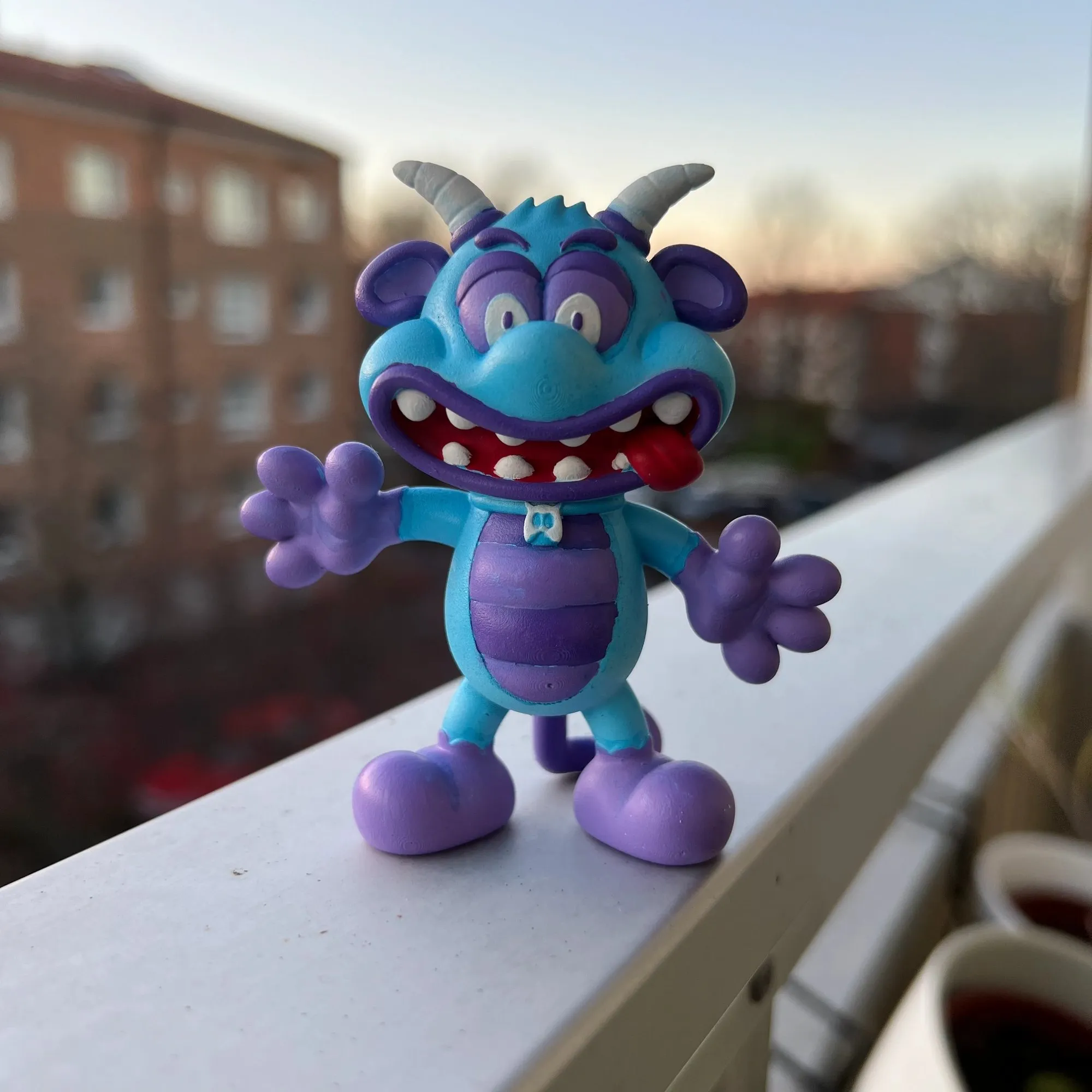
Captain Bpop had the same kind of problem in a milder form: its gloves and legs had to be changed because they didn’t work in the moulds.
Parts and joints
Every separate part means another mould, another step in assembly, and often another mask for painting.
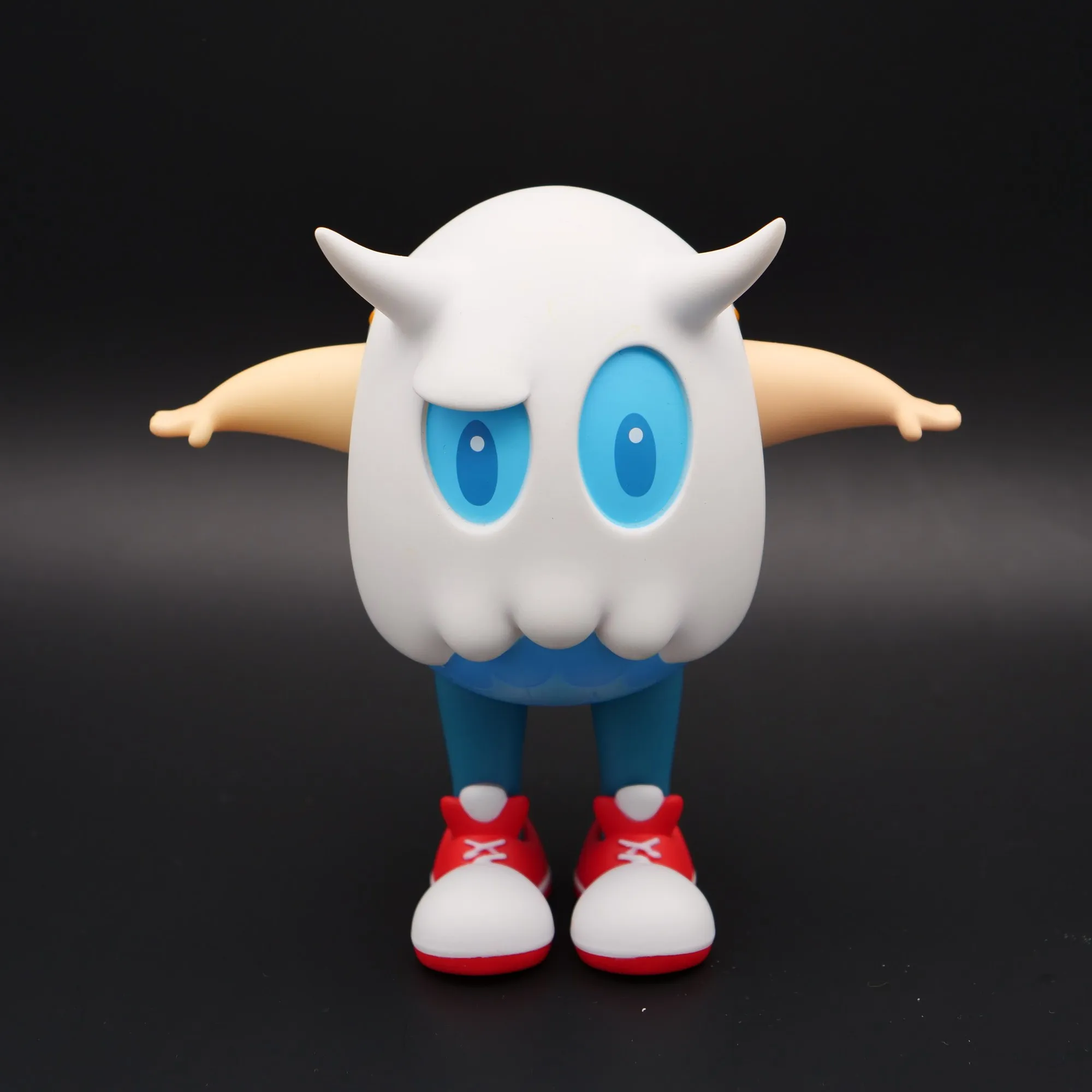
- Eggie has many separate pieces: backpack, hands, legs and shoes. That made it hard to paint in numbers.
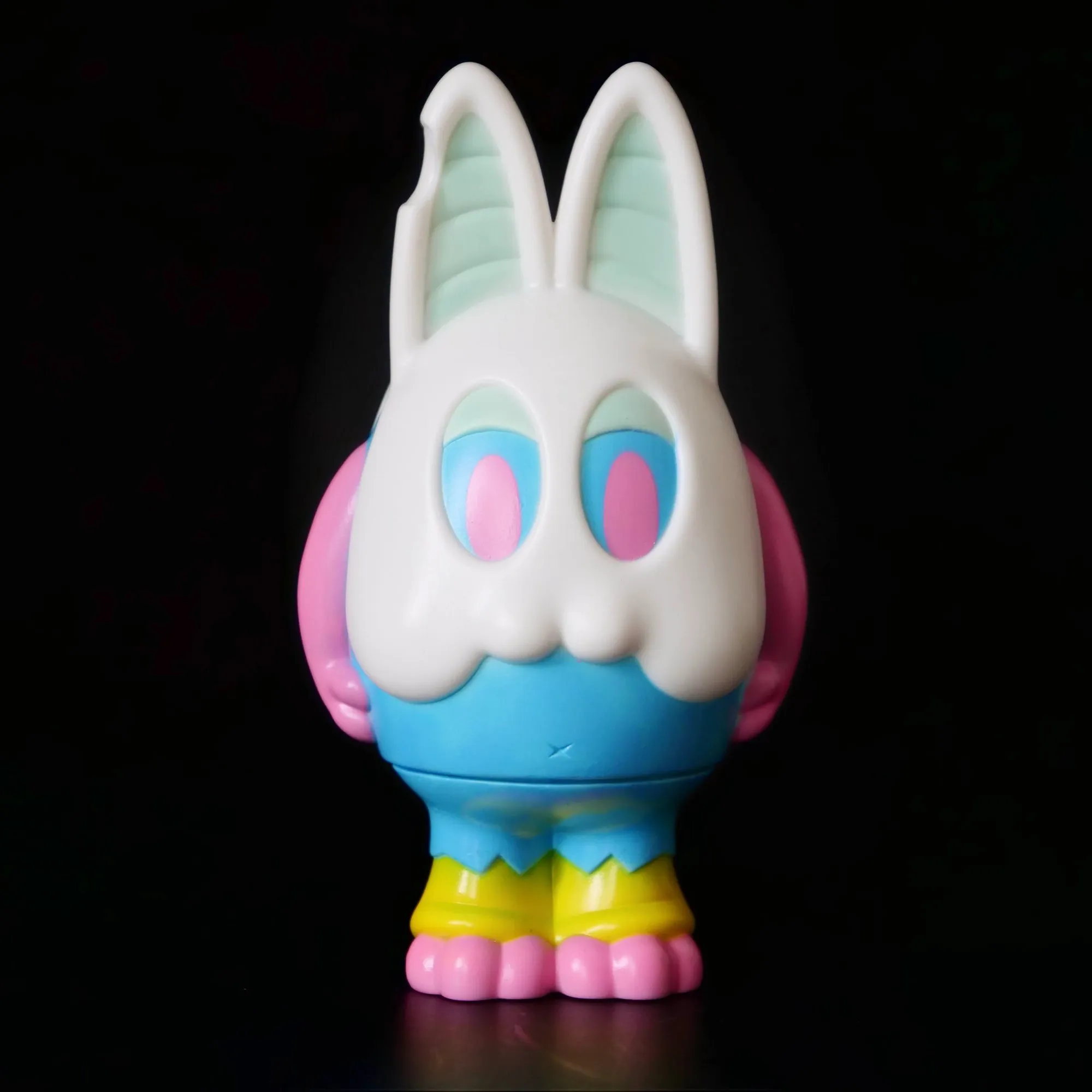
- Bonnie was designed for sofubi from the start, in two main parts, body and legs, and it was much easier to produce.
- Movable joints need extra care. With my later figures, the factory sometimes found that a joint didn’t work or a head turned the wrong way, which meant more back-and-forth and more time.
Design the joints together with the parts, and ask yourself how each piece will come out of its mould and fit onto the next.
Colours and masks
Colour is part of the production design too. Every colour that has to be sprayed in an exact place may need a metal mask, and masks are expensive. Captain Bpop ended up with around thirty to thirty-six of them because I designed it with too many colours and details.
A simple form with about three main colours is far easier to paint in a batch than a figure covered in small two-tone details.
Late changes cost money: the Eggie story
Eggie was my first own vinyl toy, and it shows almost every way a design can change after it leaves your desk.
- The mask that never was. My first idea was an egg wearing a removable mask. I dropped it, because a mask that fits over the widest part of the body without sitting loose is very hard to make.
- Feathers added late. I added the feathers after the 3D model was finished. The factory first drew them on by hand, and they looked horrible, so they had to be sculpted properly, at extra cost.
- Two kinds of vinyl. I wanted the whole toy rotocast, but the legs had to be injection-moulded at another factory, which caused a long delay.
- Smaller than expected. The finished toy came out smaller than in my design.
In the end I was very happy with Eggie. But each of those surprises would have been cheaper to solve on paper.
Give the design time
Put a finished design away for a month or two, and keep designing others. Each new one tends to be better. Then lay them all out, choose, and adapt the one you choose to the moulding process. Fixing a mistake later costs a lot of money.
A checklist before you send anything to a factory
- I know the material: sofubi, hard vinyl or resin.
- No thin, fragile protrusions or tiny loose details.
- As few separate parts as the design allows.
- Every joint planned: how it fits, how it moves.
- Around three main colours, and I know which areas need masks.
- All details are in the 3D model, not added later.
- I have checked the real size against the design.
- I have slept on it for a few weeks.
From sketch to prototype covers the next step: turning the drawing into a 3D model and a test print. Paint masks for sofubi goes deeper into masks.
Sources
I wrote this article from these videos of mine. Safety and product facts are checked against the manufacturers’ published data.